Kids' Space Corner
Space is huge, and the best way to feel how huge is to build it yourself. Here are some quick facts to share, two scale-model activities that use real NASA distances, and a few answers for grown-ups.
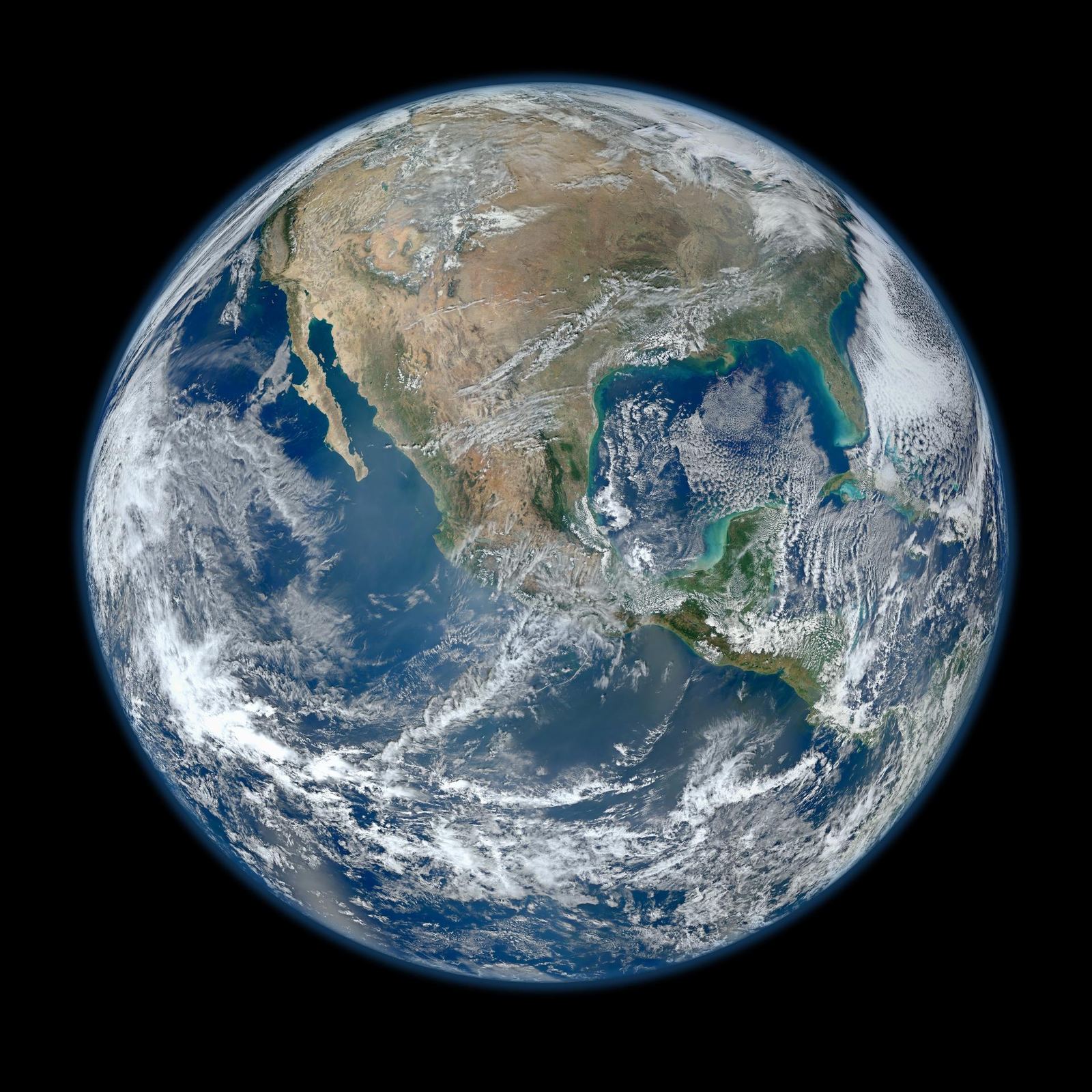
Blue Marble 2012 from the Suomi NPP satellite: NASA Goddard Space Flight Center, Public domain
Fast facts to share
The Sun is a giant
About 1.3 million Earths could fit inside the Sun. It is a star, just like the ones you see at night, only much closer.
A day longer than a year
Venus spins so slowly that one day there lasts longer than its whole trip around the Sun. It also spins backwards, so the Sun rises in the west.
A rusty planet
Mars is red because the iron in its dirt has rusted, like an old bike left in the rain.
The tallest volcano
Olympus Mons on Mars is more than 25 miles (40 km) tall from base to summit, several times taller than Mount Everest, and its base is about as big as the state of Arizona.
Speedy spinner
Jupiter is the biggest planet, yet it spins the fastest. A whole day there lasts less than 10 hours.
Saturn would float
Saturn is mostly gas and is lighter for its size than water. If you found a bathtub big enough, it would bob on top.
The sideways planet
Uranus is tipped right over on its side, so it rolls around the Sun like a bowling ball instead of spinning like a top.
Pluto and its big buddy
Pluto is a dwarf planet. Its moon Charon is about half Pluto's size, so the two look almost like a double world.
Build the solar system to scale
Both models use NASA's average distances from the Sun. We measure in AU, short for astronomical unit: one AU is the average distance from Earth to the Sun, about 150 million km.
Activity 1: The toilet-paper solar system
One sheet of toilet paper equals one AU. You need one roll, a marker and a long hallway or a stretch of floor about 4 metres long.
- Place the Sun Draw a big yellow Sun at the very start of the roll, right on the edge of the first sheet.
- The inner planets Mercury goes 0.4 of a sheet from the Sun, Venus at 0.7, Earth at exactly 1 sheet and Mars at 1.5 sheets. Notice how crowded they are.
- Jupiter and Saturn Count out to 5.2 sheets for Jupiter and 9.6 sheets for Saturn. Suddenly there is a lot of empty paper.
- Uranus and Neptune Keep unrolling: Uranus at 19.2 sheets and Neptune at 30.2 sheets.
- Find Pluto Pluto's average distance is 39.5 sheets. Its orbit is stretched, so in real life it swings closer and farther than that.
- Talk about it Ask: how many sheets would you need to walk from Earth to Neptune? (About 29.) That is a trip of about 4.4 billion km.
Tip: Sheets are not all the same size, which is fine. The model works because every planet uses the same sheet as its ruler.
Activity 2: The park-sized solar system
Now one metre equals one AU, and you also shrink the planets to the same scale. You need a tape measure or long string, a few small objects, and a park or a long corridor at least 40 metres long.
- Make the Sun At this scale the Sun is only about 9 mm across, roughly the size of a pea. Put it at your starting line.
- Walk out the inner planets Mercury at 0.4 m, Venus at 0.7 m, Earth at 1 m and Mars at 1.5 m. Earth is just 0.09 mm wide here, about the thickness of a hair, and the Moon would be under 3 mm away from it.
- Walk out the giants Jupiter at 5.2 m, about 1 mm across, like a pinhead. Saturn at 9.6 m, Uranus at 19.2 m and Neptune at 30.2 m.
- Pluto at the edge Pluto sits at about 39.5 m on average. Turn around and look back at your pea-sized Sun.
- Spot the lesson Almost everything in the solar system is empty space. That is why most pictures of the planets in a row cannot show sizes and distances to the same scale.
Tip: Earth is so tiny at this scale that you can mark its spot with a flag and just pretend the planet is there.
For parents and teachers
Do we need a telescope to get kids into space?
No. The Moon, bright planets like Venus and Jupiter, and meteor showers all look great with just your eyes. A pair of ordinary binoculars is the best first upgrade: they show craters on the Moon and Jupiter's four big moons.
How did you work out the scale-model distances?
We divided NASA's average distance of each planet from the Sun by Earth's average distance of 149.6 million km. For the park model we divided the real diameters by the same number to get the planet sizes in metres.
Why is Pluto not a planet any more?
In 2006 the International Astronomical Union created the category of dwarf planet. Pluto fits it because it has not cleared its orbit of other objects. It is still a real world with mountains, glaciers and five known moons.
Is it ever safe to look at the Sun?
Never look straight at the Sun, with or without binoculars or a telescope, because it can permanently damage eyes. Only use certified solar viewers made for eclipse watching.
What is a good first night out?
Pick a night near first quarter Moon, when the Moon is up in the evening and its craters stand out. Our night-sky page lists the dates each month.
- NASA NSSDCA: Planetary Fact Sheet (Metric)
- NASA Science: Sun Facts
- NASA Science: Venus Facts
- NASA Science: Mars Facts
- NASA Science: Pluto Facts
- NASA Science: Skywatching
Facts on this page were checked against these sources (updated Oct 1, 2026). Spot an error? Email hello@fireempireshop.com.