
Space Events to Watch, 2026 to 2027
Late 2026 is a busy season in deep space. Here are the spacecraft milestones and the big sky events of early 2027 worth putting in your calendar, each with the agency or almanac we checked it against.
Spacecraft schedules can slip by days or weeks. Items marked estimate have only a month or a range published so far.
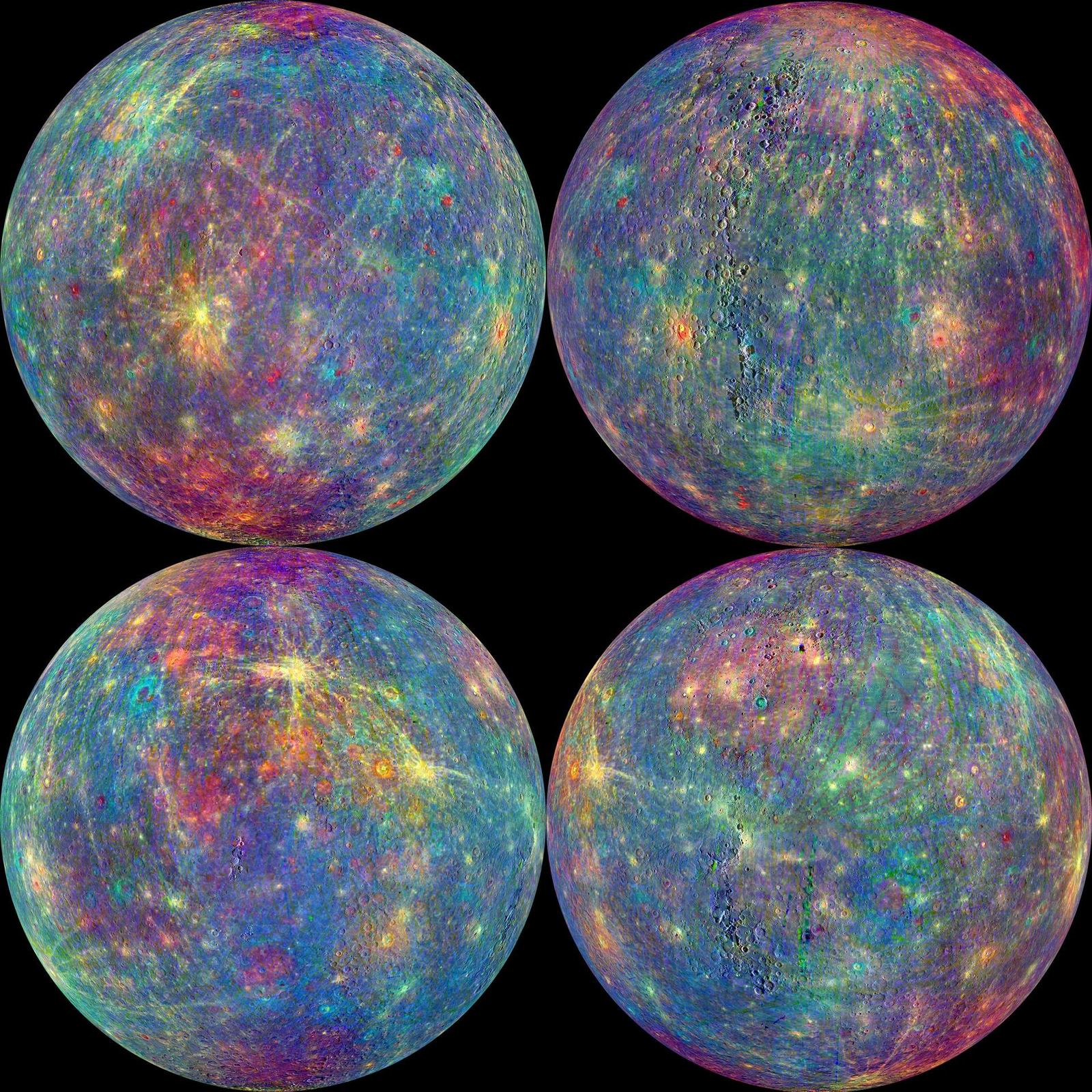
Mercury in enhanced color from MESSENGER: NASA/Johns Hopkins University Applied Physics Laboratory/Carnegie Institution of Washington, Public domain
Spacecraft milestones
Hera arrives at its twin asteroids estimate
ESA's Hera is due to rendezvous with Didymos and its small moon Dimorphos, the asteroid NASA's DART spacecraft hit in 2022, to measure exactly what the impact changed. ESA's pages describe the arrival as October to November 2026.
Source: esa.intBepiColombo enters orbit around Mercury confirmed
After an eight-year trip, the joint European and Japanese spacecraft is scheduled to be captured into orbit around Mercury. Its cruise module already separated on 3 September 2026.
Source: esa.intEuropa Clipper flies past Earth confirmed
NASA's Europa Clipper swings by Earth for a gravity assist that sends it on toward Jupiter, where it is due to arrive in April 2030 to study the ocean moon Europa.
Source: science.nasa.govBepiColombo's two orbiters split confirmed
ESA's Mercury Planetary Orbiter and Japan's Mio are planned to separate on 9 to 10 December 2026, each heading for its own orbit around Mercury.
Source: esa.intBepiColombo starts science estimate
ESA says science operations for both Mercury orbiters begin in April 2027. No exact day has been published.
Source: esa.int
All the dates on this list have passed. A fresh list is on the way.
Big sky dates in early 2027
Annular solar eclipse confirmed
The New Moon passes in front of the Sun but is too small to cover it, leaving a ring of sunlight along a narrow path. Check eclipse maps for where it is visible, and never look without proper solar filters.
Source: astropixels.comJupiter at opposition confirmed
Jupiter rises at sunset and is up all night at its biggest and brightest for the year. Binoculars show its four large moons.
Source: astropixels.comMars at opposition confirmed
Mars is opposite the Sun and visible all night. This is a distant opposition, so Mars will look smaller in a telescope than at its best, but it will still shine bright orange.
Source: astropixels.comPenumbral lunar eclipse confirmed
The full Moon slips through Earth's outer shadow. The dimming is subtle: look for a soft grey shading on one side of the Moon around 23:13 UTC.
Source: astropixels.com
All the dates on this list have passed. A fresh list is on the way.
Mission dates come from ESA and NASA announcements as of 1 October 2026 and can change. Check the linked mission pages for live updates.
- ESA: Latest updates, BepiColombo's arrival at Mercury
- ESA: BepiColombo begins Mercury arrival with MTM separation success
- ESA: BepiColombo arrival media kit
- ESA: Hera
- ESA: Hera operations
- NASA Science: Europa Clipper
- AstroPixels: Sky Event Almanac 2027 (GMT)
Facts on this page were checked against these sources (updated Oct 1, 2026). Spot an error? Email hello@fireempireshop.com.