Mercury
The scorched planet that hides ice. Mercury is the smallest planet and closest to the Sun, yet its dark polar craters hide water ice. Explore its extremes, missions and facts.
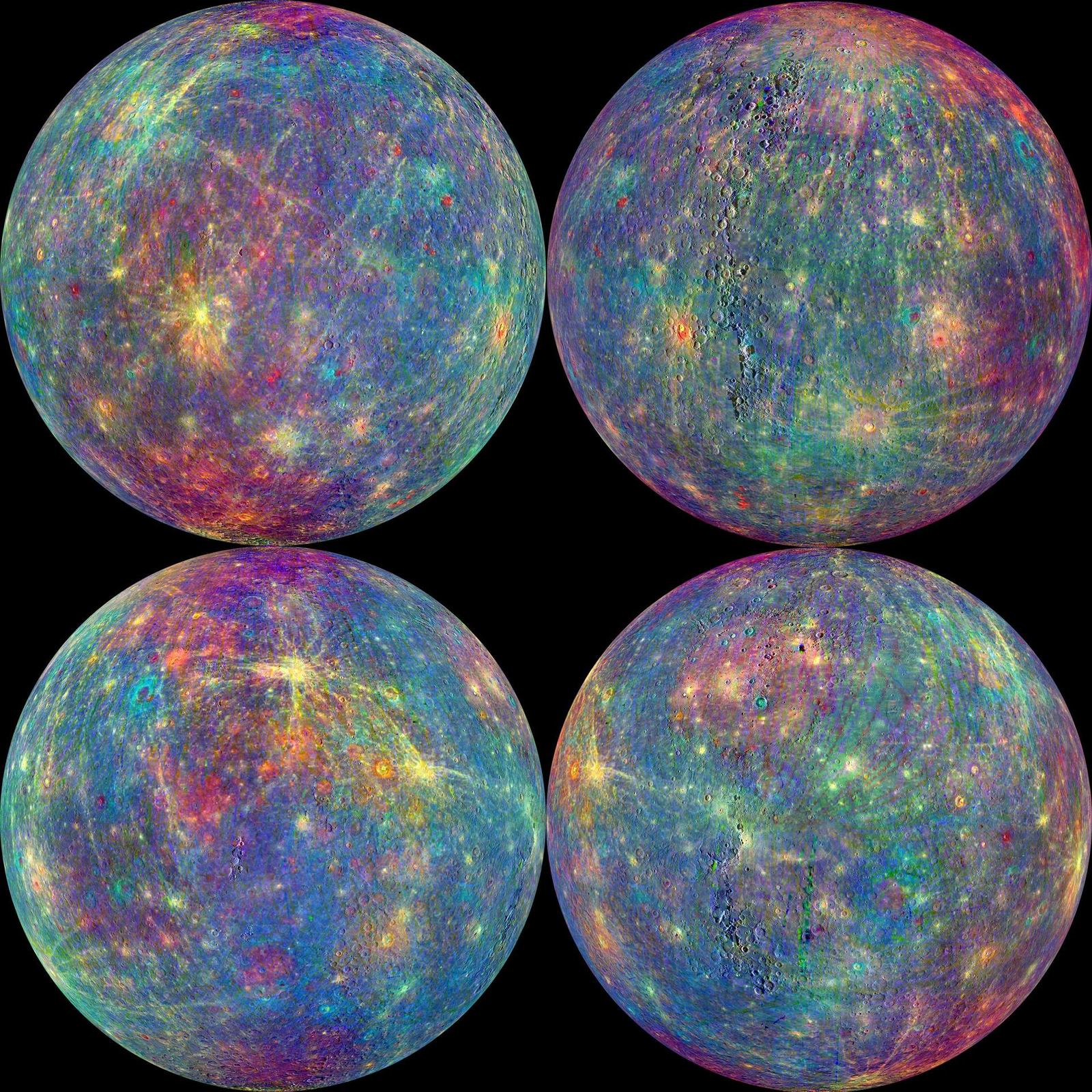
Mercury in enhanced color from MESSENGER: NASA/Johns Hopkins University Applied Physics Laboratory/Carnegie Institution of Washington, Public domain
A world of extremes
Mercury races around the Sun faster than any other planet, finishing a lap in just 88 Earth days. But it turns on its axis very slowly, so a single day, from one sunrise to the next, lasts about 176 Earth days. That is two of its years.
Because Mercury has almost no atmosphere to hold heat, its temperatures swing wildly. In daylight the ground bakes at about 430 °C, hot enough to melt lead. After sunset, the heat radiates straight into space and the surface plunges to around -180 °C. That is one of the biggest day-to-night temperature swings of any planet.
Standing on Mercury, the Sun would look about three times wider than it does from Earth. Because of the planet's slow spin and fast, stretched orbit, there are places where the Sun would appear to rise, pause, briefly back up and then continue across a black sky, since there is no air to scatter light and turn it blue.
Video: Mercury's Ice Lockers. Credit: NASA's Goddard Space Flight Center (source). NASA media; no endorsement implied.
The planet closest to the Sun has ice on it
Mercury's dayside reaches about 430 C, yet NASA's MESSENGER found evidence of water ice in permanently shadowed polar craters that stay colder than -170 C.
YouTube @Planetinio (launching soon). Photos in this Short: MESSENGER first photo of unseen side of mercury.jpg - NASA/Johns Hopkins University Applied Physics Laboratory/Car (Public domain) via Wikimedia Commons | Mercury in color - Prockter07 centered.jpg - NASA/Johns Hopkins University Applied Physics Laboratory/Car (Public domain) via Wikimedia Commons | Mercury in color - Prockter07-edit1.jpg - National Aeronautics and Space Administration/Johns Hopkins (Public domain) via Wikimedia Commons | Mercury in true color.jpg - NASA/Johns Hopkins Universit
Ice on the planet closest to the Sun
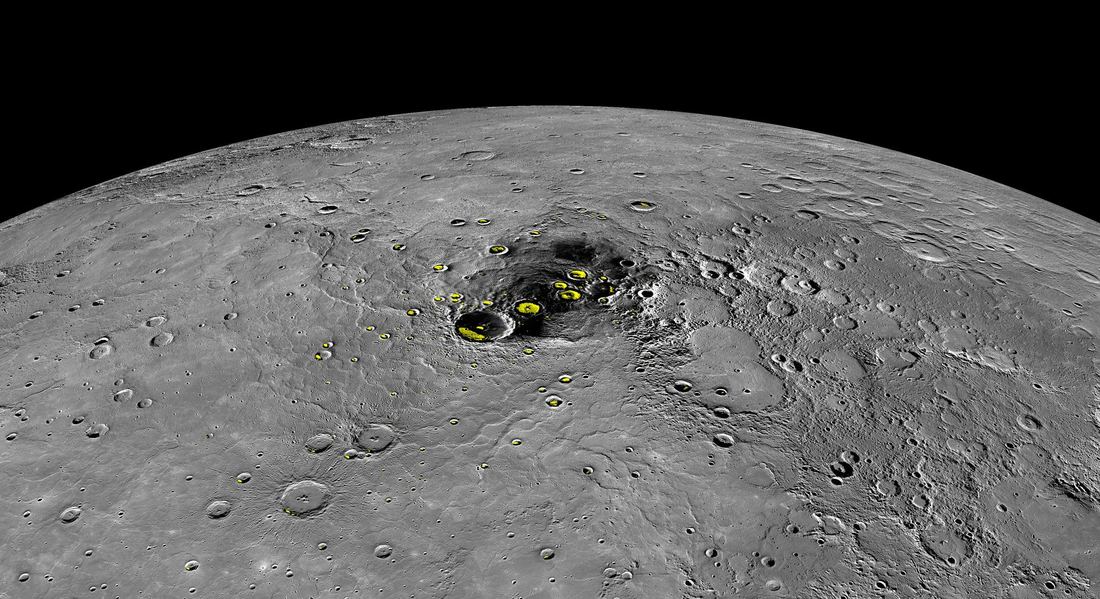
Here is the surprise: Mercury has ice. Its axis is barely tilted, so the floors of some deep craters near the poles never see sunlight at all. Those permanently shadowed pockets stay colder than about -170 °C, cold enough to trap water ice for billions of years.
Radar from Earth first hinted at bright, icy deposits in the 1990s. In 2012 NASA's MESSENGER spacecraft confirmed it, measuring the cold temperatures, detecting hydrogen and even spotting dark material that may cover and protect some of the ice. Scientists think comets and water-rich asteroids delivered it over time.
A shrinking, iron-hearted planet
Mercury is only a little larger than our Moon, and at first glance it looks similar, gray and covered in craters. Inside, though, it is very different. An enormous iron core fills most of the planet, making Mercury the second densest planet after Earth. That core also generates a weak magnetic field.
As Mercury's interior cooled over billions of years, the whole planet contracted. Its crust wrinkled into long cliffs called lobate scarps, some of them hundreds of kilometers long and more than a kilometer high. Its biggest impact scar, the Caloris Basin, is about 1,500 km wide.
Hard to reach, despite being close
Getting to Mercury is surprisingly tricky. A spacecraft falling toward the Sun picks up so much speed that it has to brake hard to stay in orbit. Mariner 10 flew past three times in 1974 and 1975. MESSENGER needed six planetary flybys to slow down before it entered orbit in 2011, then mapped the entire planet until it was deliberately crashed into the surface in 2015.
The European and Japanese BepiColombo mission, launched in 2018, has been looping past Earth, Venus and Mercury to set up its own arrival, due in November 2026, with two orbiters designed to study the planet from different angles.
Facts on this page were checked against these sources.
- Mercury in enhanced color from MESSENGER: NASA/Johns Hopkins University Applied Physics Laboratory/Carnegie Institution of Washington, Public domain
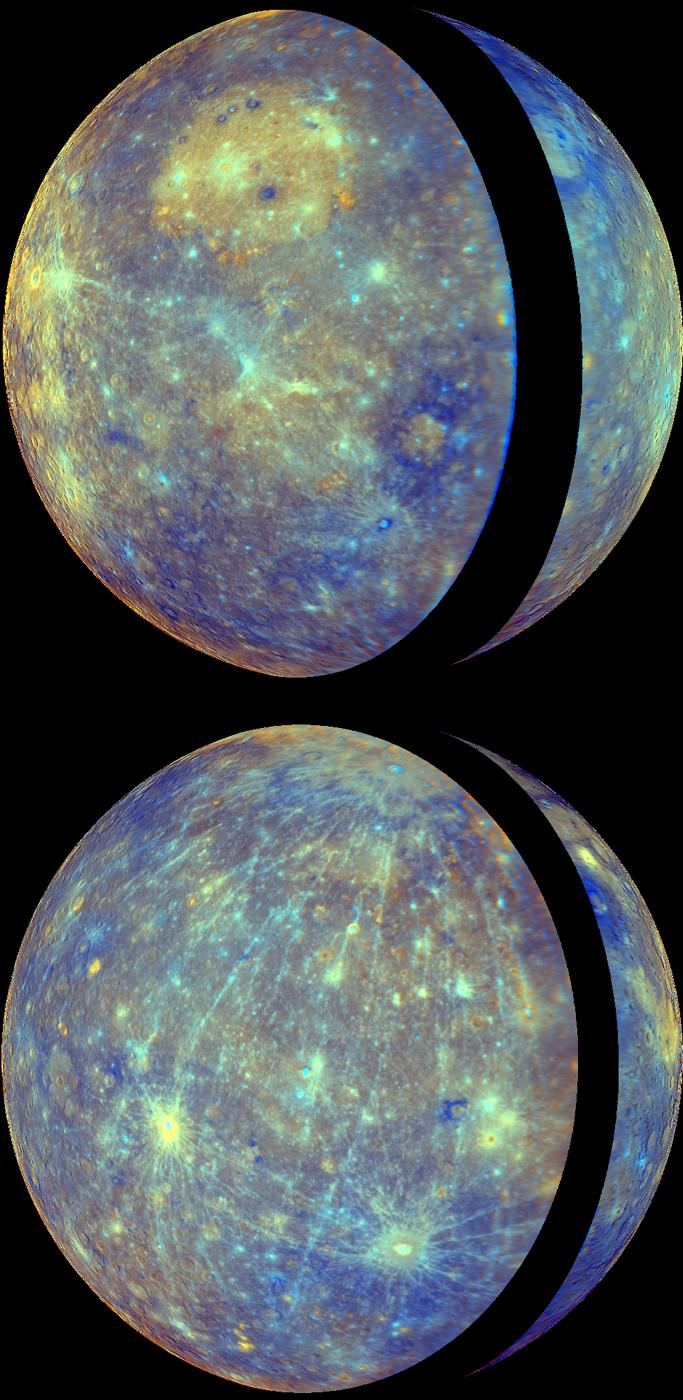
- A global view of Mercury's surface: NASA/Johns Hopkins University Applied Physics Laboratory/Smithsonian Institution/Carnegie Institution of Washington, Public domain
- Water ice in Mercury's north polar craters: NASA/Johns Hopkins University Applied Physics Laboratory/Carnegie Institution of Washington, Public domain
- Video: Mercury's Ice Lockers, NASA's Goddard Space Flight Center, NASA (public domain)
- Short photos: MESSENGER first photo of unseen side of mercury.jpg - NASA/Johns Hopkins University Applied Physics Laboratory/Car (Public domain) via Wikimedia Commons | Mercury in color - Prockter07 centered.jpg - NASA/Johns Hopkins University Applied Physics Laboratory/Car (Public domain) via Wikimedia Commons | Mercury in color - Prockter07-edit1.jpg - National Aeronautics and Space Administration/Johns Hopkins (Public domain) via Wikimedia Commons | Mercury in true color.jpg - NASA/Johns Hopkins University Applied Physics Laboratory/Ari (Public domain) via Wikimedia Commons | Radar-bright Deposits near Mercury's North Pole messenger orbit image20120322.jpg - NASA/Johns Hopkins University Applied Physics Laboratory/Car (Public domain) via Wikimedia Commons | North pole of Mercury -- NASA.jpg - NASA (Public domain) via Wikimedia Commons | MESSENGER - spacecraft at mercury - atmercury lg.jpg - NASA / JHU/APL (Public domain) via Wikimedia Commons | Messenger.jpg - The original uploader was The Epopt at English Wikipedia. La (Public domain) via Wikimedia Commons
Text written by Planetinio.